Moon Without Skin
THIS IS A WORK OF FICTION
On the evening the moon first looked diseased, Partha Chatterjee was drinking tea from a small glass at a stall beside the Shyambazar crossing, under tram wires blackened by dust and old rain. The air had the tired dampness of a towel that had failed to dry for generations. Above the five-point traffic, political posters flapped against peeling cinema advertisements, and the metro announcement floated up from somewhere below the road, a woman’s calm recorded voice telling the buried city where it might go next.
The tea-stall owner, Haru, had hung his phone from a nail with a rubber band and was watching a reel in which a man in Gurugram explained the end of the world with the confidence of a refrigerator salesman.
“See this,” Haru said. “Moon has chicken pox.”
Partha did not look at the phone. His left knee had been hurting since afternoon. His mother was waiting at the flat with her sugar medicine, and the delivery app had still not assigned a rider for the insulin pen he had ordered from a pharmacy in Lake Town. He had spent fifteen years in hospital data systems in Texas and another decade in Kolkata being almost useful, which is to say consultants called him when they needed an old man who understood bad databases and paid him after two reminders and one humiliation.
Then the lights went out.
Not everywhere. That would have been dramatic and therefore unlikely. The paan shop stayed lit, its inverter coughing on. The pharmacy flickered. The coaching center on the first floor, where pale boys and girls were being prepared for examinations that would make a few of them employable and most of them quietly ashamed, glowed blue behind grilled windows. But the street itself dimmed, and the sky appeared suddenly, as if someone had taken the lid off the city.
People looked up.
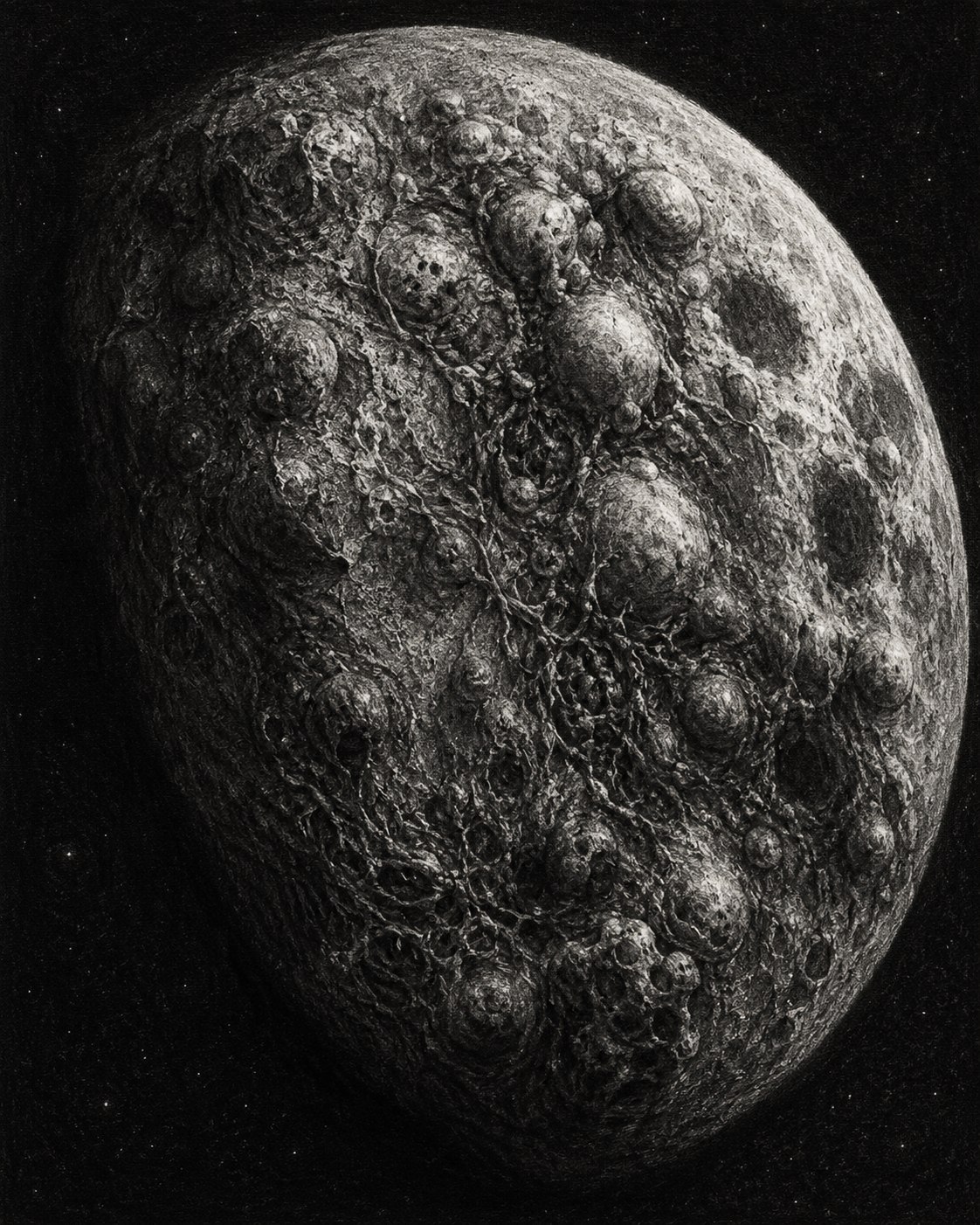
At first Partha thought it was cloud. The monsoon had been threatening for days. But the moon had risen fat and low beyond the old buildings, and across its face were lumps, grey-white swellings like blisters under dead skin. Some were small as lentils. Some bulged with the obscene confidence of overripe fruit. The Sea of Tranquility was hidden under a cluster of rounded knots.
Haru made a sound, half laugh, half prayer. “Baba re.”
A delivery rider had stopped at the crossing, one foot on the road, helmet visor raised. He was young, narrow-shouldered, wearing a yellow rain jacket although it had not rained. He took three photographs, then lowered the phone and looked with his naked eyes.
“Not filter,” he said.
Nobody answered him.
That was how the first truth entered Kolkata: not through NASA, not through ISRO, not through a minister’s solemn face, but through a tea stall, a power cut, and twenty people briefly made equal by fear.
By nine o’clock, the moon was on every screen.
By ten, the experts had arrived with their ladders of explanation. Volcanic extrusion. Visual artifact. Solar scattering. Coordinated hoax. Atmospheric lensing caused by particulate moisture. A private news channel brought in a retired geologist who said the moon was dead and therefore could not develop anything, which comforted people for seven minutes, until a telescope livestream from Japan showed one of the lumps splitting open like a bud.
Partha watched from the balcony of his rented flat in Sinthee, where rainwater had collected in a plastic bucket beside the cracked parapet. His mother slept in the next room beneath a slow fan. On the wall, the old calendar still showed May because he had not had the moral strength to turn the page.
His phone buzzed.
It was Ananya Sen.
He stared at her name for a moment before answering. They had not spoken in three months, not since she had told him, with the exhausted politeness of a woman who had spent her day telling families worse things, that he could not keep disappearing and returning with apologies like medical bills.
“Are you seeing it?” she asked.
“Yes.”
“Not just seeing. I mean really seeing.”
Ananya was an oncologist at a private hospital near EM Bypass, one of those glass-fronted towers where suffering arrived in app cabs and left as debt. She had once joked that India had solved immortality by making dying too expensive to complete.
Partha leaned against the balcony grille. A mosquito whined near his ear. “What am I supposed to see?”
“The distribution,” she said.
He looked up again.
The lumps were not random. That was the awful thing. They gathered along pale branching lines, as if some invisible vascular system had been fed. One growth near the lower rim pulsed faintly, swelling and sinking with the patience of a sleeping throat.
“You think it looks metastatic,” Partha said.
“I think it looks staged.”
Below, in the lane, a group of boys shouted at one another while filming reaction videos. Someone had begun blowing a conch from a balcony. From another flat came the tinny sound of a devotional song, competing with a news anchor’s panic.
Ananya said, “I sent you images. Compare with the old lunar maps. Use the segmentation model you made for breast lesions.”
“That model was a toy.”
“It found my father’s recurrence six weeks before the radiologist.”
“It found shadows.”
“Partha.”
He closed his eyes. In America, his skill had been finding wrongness inside neat tables: a swapped code, a fake date, a cancer registry that had eaten its own tail. In Kolkata, wrongness did not hide inside tables. It sat openly in clinics, police stations, apartment meetings, relatives’ smiles. It was not hard to find. It was only impossible to invoice.
“I’ll look,” he said.
The files arrived over a failing connection. Moon images from observatories in Chile, Ladakh, South Africa, Australia. He pulled old public lunar maps, loaded them into the cracked laptop on his dining table, and began aligning the images.
At midnight the insulin pen arrived. The delivery rider was the same young man from Shyambazar.
“You’re far from there,” Partha said, surprised.
The boy shrugged. His name tag said Riddhi. His face was wet with sweat, though the night had cooled. “Orders are going mad. People buying fever medicine, iodine, holy basil, condoms, telescope, everything. One man ordered eight packets of incense and a blood pressure machine.”
Partha almost laughed. “Come in for water.”
Riddhi hesitated with the instinctive caution of the gig worker, who knows that every doorway is a possible complaint. Then he stepped inside.
The flat was small, clean in the embarrassed way of bachelor households. Riddhi drank two glasses of water standing near the door. On the laptop screen, the moon’s tumorous face rotated slowly beside a medical scan.
“You are scientist?” he asked.
“No. Worse. Data man.”
Riddhi leaned closer. “It looks like my mother’s report.”
Partha looked at him.
“Liver,” the boy said. “Last year. They showed picture. Spots everywhere.”
“I’m sorry.”
“Hospital said targeted therapy. Target was our bank account.”
There it was, Partha thought, the new Indian family portrait: one sick parent, one educated child doing delivery work, one hospital billing desk with a smile professionally trained not to tremble.
Riddhi pointed at the screen. “Why are some lumps brighter?”
“Active growth, maybe. Heat. Or reflected sunlight from raised surfaces.”
“Moon cannot get cancer.”
“No.”
“But it got.”
Partha had no answer.
At two in the morning, the software finished its first comparison. The pattern of lunar growths did not match impact basins, lava plains, mineral deposits, or known underground structures. It matched something else with indecent elegance.
Ananya answered on the first ring.
“Primary with diffuse satellite nodules,” Partha said.
She exhaled. “Yes.”
“Except the scale is impossible. The primary mass is almost four hundred kilometers wide.”
“Where?”
“Far side. We can’t see it directly. But the visible lesions are fed from there.”
They were silent for a while.
Then Ananya said, “There’s more. We admitted three patients tonight with identical skin growths.”
Partha sat straighter. “Identical to each other?”
“Identical to the moon.”
The first was a taxi driver from Behala who had waited six hours at a government hospital before his nephew borrowed money and moved him to Ananya’s hospital. The second was a woman from a gated tower in New Town who owned three air purifiers and cried because the lump on her neck would show during her daughter’s engagement photos. The third was a retired school clerk from Dum Dum who apologized to every nurse for existing.
“All three noticed swelling after moonrise,” Ananya said. “Biopsies are being rushed.”
“Radiation?”
“No. Blood counts strange but not radiation. Cells are dividing, then stopping, then dividing again. Like something is testing rates.”
Partha looked toward his mother’s room.
“Is it contagious?”
“I don’t know.”
“What do they have in common?”
“Nothing obvious.”
“There is always something.”
“You sound like yourself,” she said, and then regretted it.
He let that pass. “Send me their addresses.”
“That is illegal.”
“So is the moon.”
She sent them.
Partha plotted the addresses with the lunar lesion map open beside them. Behala. New Town. Dum Dum. Three points in a sprawling city of impatience and tea stains. Meaningless.
Then he added the time each patient first noticed symptoms.
The software made a small error sound, the kind that had survived from older operating systems like a mechanical insect.
The points aligned not with the city, but with the moon’s visible lesions at the exact angle of moonrise, as if something had drawn a line from each swelling to a human witness below.
He called Ananya.
“We are not infected,” he said. “We are being sampled.”
In the morning, Kolkata behaved as Kolkata does when history bangs on the door: it opened one eye, cursed the noise, and asked the price of potatoes.
Markets filled. Buses groaned. Tea boiled. Office clerks discussed apocalypse beside the price of fish. At Sovabazar, a man sold smoked glasses for viewing the moon safely, though the moon had set hours ago. At a crossing near the hospital, someone had pasted a poster: THE SKY IS FOREIGN CONSPIRACY. Beneath it, another poster promised admission guidance for medical entrance exams.
Partha went to Ananya’s hospital wearing a mask, though no one knew what masks were for anymore. The lobby smelled of sanitizer, perfume, and financial terror. Families sat under cold lights holding files like offerings. On the television, a panel shouted about whether the moon growths were divine punishment, alien mining, or a deepfake by Western agencies.
Ananya met him near the oncology wing. She looked older than three months ago, which was unfair because he had not been there to watch it happen gradually.
“You shouldn’t have come,” she said.
“You asked me.”
“I asked your laptop.”
They stood too close, then too far.
She took him to a side room where Riddhi sat on a chair, helmet in his lap.
“What are you doing here?” Partha asked.
Riddhi gave a weak smile. “Delivery.”
On his right wrist, just above the glove line, was a small pearl-grey lump.
Ananya said, “He came to bring food to a patient’s family. I saw him scratching.”
Riddhi looked ashamed, as if illness were misconduct.
“It doesn’t hurt,” he said. “Only feels like someone is remembering me from inside.”
Ananya removed the dressing. The lump was the size of a marble, smooth, faintly translucent, with tiny red lines at its base. It was hideous not because it was bloody or large, but because it looked purposeful.
Partha photographed it. The image recognition model matched it to a new lunar nodule near Mare Imbrium with ninety-eight percent confidence.
Riddhi laughed once. “So I am famous.”
By evening there were eighty-seven known cases in Kolkata, then four hundred across the world, then the numbers stopped meaning anything because governments began disagreeing with hospitals, hospitals with laboratories, and laboratories with their own machines.
A transmission came at 8:12 p.m.
Every phone in the city received it. Not a message exactly. A picture. A grey field with a branching structure and a sequence of pulses. It lasted nine seconds, then vanished from devices that tried to replay it.
But Partha’s old laptop, being too outdated for modern obedience, kept a corrupted copy.
He and Ananya and Riddhi watched it in Partha’s flat while his mother slept and rain finally began tapping on the balcony grille.
“It’s not language,” Riddhi said.
“It’s data,” Partha said.
Ananya leaned over his shoulder. “Medical?”
“Experimental log.”
He slowed the pulses and mapped them against the growth phases on the moon. The signal contained repeating sets: introduce agent, observe proliferation, adjust suppression, record host response.
“Alien experiment,” Riddhi whispered.
“Gone wrong,” Ananya said.
Partha kept reading the pattern. His mouth had gone dry.
“No,” he said. “Not exactly.”
The signal did not describe the moon as the subject. It described it as the control surface.
“Control for what?” Ananya asked.
Before he could answer, the power went out again.
In darkness, his mother called from the other room, “Partha?”
He went to her. She was sitting up in bed, small under the mosquito net, her white hair loose around her face. On her forehead, just at the hairline, was a round grey swelling.
For one foolish second he thought of childhood injuries: Dettol, cotton, his mother’s hand steady as law.
“When did this happen?” he asked.
She touched it. “This? Long time.”
“No.”
“Since you were small. It comes and goes.”
Ananya came in behind him and froze.
The lump on his mother’s forehead pulsed once.
Outside, the rain thickened. Somewhere in the lane, a transformer exploded with a blue flash. People shouted. The city’s buildings, old and new, stood packed together like patients in a ward no doctor had time to visit.
Partha asked his mother, carefully, “Ma, did anything happen when I was small? Something with light? Sky?”
She looked irritated. “Always questions. You were born during load-shedding. That was light enough.”
“Think.”
She sighed. “There was one night. Before you were born. Moon became black for some time, then too bright. Your father said eclipse. Our neighbor said omen. Next day many women in the para had fever.”
Ananya whispered, “What year?”
“Seventy-four,” his mother said. “Or seventy-five. Who remembers? Rice was expensive. Your father lost his temper over kerosene.”
Partha returned to the laptop with the helpless speed of a man running down a corridor in a dream. He searched old astronomical records, old newspaper scans, anything. There had been no eclipse visible from Kolkata on the date his mother gave. But there had been reports, buried in district papers, of a strange pallor on the moon, failed radio reception, livestock miscarriages, fever clusters dismissed as viral.
He entered his own birth date. April 1975.
The corrupted alien log opened another layer.
A list appeared: not in words, but in intervals, coordinates, gestation markers. Trial cycles. Host adaptation. Suppression failure. Reset attempts.
Ananya’s face had gone bloodless.
“What is it?”
Partha could not speak at first.
All his life he had thought of himself as a failed local product of ordinary sadness: a Bengali middle-class son with too much education, too little money, a mind that turned against itself, and a mother who had survived everything except peace. Now the screen told him that this biography had another author.
The lunar tumors were not the beginning of the experiment.
They were the autopsy.
The experiment had begun fifty-one years earlier, when something placed a self-limiting growth code into a small human population under the cover of an impossible moon event. The code had spread quietly through bloodlines, through births, through the intimate arithmetic by which a city replaces itself. Most carriers lived ordinary lives. Some developed cancers. Some developed autoimmune diseases, strange depressions, impossible recoveries, minds that burned too hot or went dark without reason. The agent had not been designed to kill. It had been designed to learn how life on Earth controlled growth.
Cancer, Ananya had once told him, was not invasion from outside. It was the body misreading permission.
The moon had been used as a mirror, a sterile stone surface on which the hidden program could finally be amplified and studied from afar. But the amplification had failed. The control surface was now growing. The moon was expressing the disease that had been rehearsed inside them for half a century.
Riddhi stood near the balcony, staring up through the rain. “So Earth is next?”
Partha looked at his mother’s sleeping form, at Ananya’s hands gripping the back of a chair, at the small lump on Riddhi’s wrist. Then he looked at his own reflection in the dark laptop screen. There, above his left eyebrow, where he had thought the headache had been sitting all day like a bad tenant, the skin had risen in a smooth grey bead.
“No,” he said.
The word surprised him by coming out calmly.
Outside, the clouds parted for a moment. The moon appeared over Kolkata, swollen and terrible, its face crowded with pale nodules that glistened in the rain-washed sky. From balconies and rooftops and hospital windows, people lifted their phones. The city looked up, frightened that the disease might descend.
Partha understood then that people always imagine catastrophe arriving from above because it preserves a final vanity: that until impact, they are innocent.
The moon did not look like a warning anymore. It looked like a report sent back too late. Earth was not next. Earth was the patient from whom the sample had been taken, the warm original mass, the beloved tumor that had learned to pray, invoice, marry, migrate, betray, and call its uncontrolled growth civilization.
On the laptop, the alien log refreshed itself one last time.
A new line appeared.
BIOPSY COMPLETE.
Then, beneath it, another.
PRIMARY SITE CONFIRMED.